Showing posts with label Stellenbosch. Show all posts

Wednesday, August 15, 2012

A Day at Koopmanskloof

So here it is folks, my purpose of traveling to South Africa. Although the award to my first fair trade certified site visit goes to Kuappa Kokoo and Volta River Estates in Ghana, this was my first time visiting a fair trade certified cite on 'business', as an Ambassador - as a Volunteer Ambassador for Fair Trade USA (...its a mouthful isn't it?).

Let me just say that since traveling alone, I've experienced situations of pure frustration. The morning I was supposed to visit Koopmanskloof was one of them. Prior to coming to Cape Town I was forewarned that renting a car would be ideal, since public transportation isn't as reliable or widespread as say, in New York. There are limits to how far a bus, train, or even affordable taxi will take you. However, from Cape Town to Stellenbosch public transportation was perfectly fine - Metrorail for R17 straight to the Stellenbosch train station which was only walking distance from Ikhaya Backpackers. Completely doable. However, getting from Ikhaya to Koopmanskloof winery was another story. The distance between the two was about 20km and my options were 1.) hire a shuttle taxi and pay R180 for a 10 minute ride or 2.) hire an even more expensive shuttle taxi because R180 is considered affordable. You can understand my frustration when I was able to get from Cape Town to Stellenbosch spending less than R17 and a mere 10 minute car ride would cost me more than 10 times that. I repeat, pure frustration!

Upon arrival I was greeted by Mario, Koopmanskloof's new Fair Trade Officer. We then met with Rydal Jeftha, the Manging Director. We spoke for an hour about his views on fair frade in general, fair frade in South Africa and BEE standards. I was honored to meet Rydal because unknowingly enough he was also responsible for Thandi's success, the world's first winery to achieve fair trade certification. In 2007 he left Thandi for Koopmanskloof with the intent to transform it into a fair trade certified winery. He left Thandi for because Koopmanskloof has the advantage of having the entire value chain located in one area whereas Thandi was only a brand and today is still only a reseller. On December 24, 2007, only 6 months after Rydal took over Koopmanskloof they achieved fair trade certification.

Koopmanskloof takes pride in the fact that they are one of the few black-owned wineries, and they should. Koopmanskloof was probably the only winery I visited where there were undoubtedly more blacks or coloured people in management positions than white. After spending an afternoon with Mario and Rydal, the genuine investment in their workers is boldly visible. As we drove around to snap a few photos and speak with several workers, Mario knew the name of each person encountered his conscious effort to maintain strong relationships with them was evident. Mario is constantly inventing new ways to give back to their workers. He recently arranged a food donation program with Pick n' Pay, organizes domino competitions on he weekends, and is planning a huge festival in December. Additional benefits for Koopmanskloof workers include daily transportation from their house to the farm, transportation each Saturday into town to go collect groceries, and an on-site creche (preschool) and primary school.

Greatest challenges with fair trade? Trying to explain to workers what fair trade is not. Most workers equate fair trade premium to extra money in their pockets, when the purpose is to financially support community development projects. So as a compromise, most fair trade premium money is spent on projects that can be easily seen in their eyes as money – food, uniforms, scholarships – essentials that they would have spent their extra money on anyway. And then of course, a commonly mentioned challenge of being fair trade certified is that it is expensive. Adhering to high environmental and quality standards requires training, which requires time, which requires money. However if you ask any owner why they became fair trade certified, they'd most likely tell you all the hoops fair trade requires you to jump through is worth it if it benefits the workers.


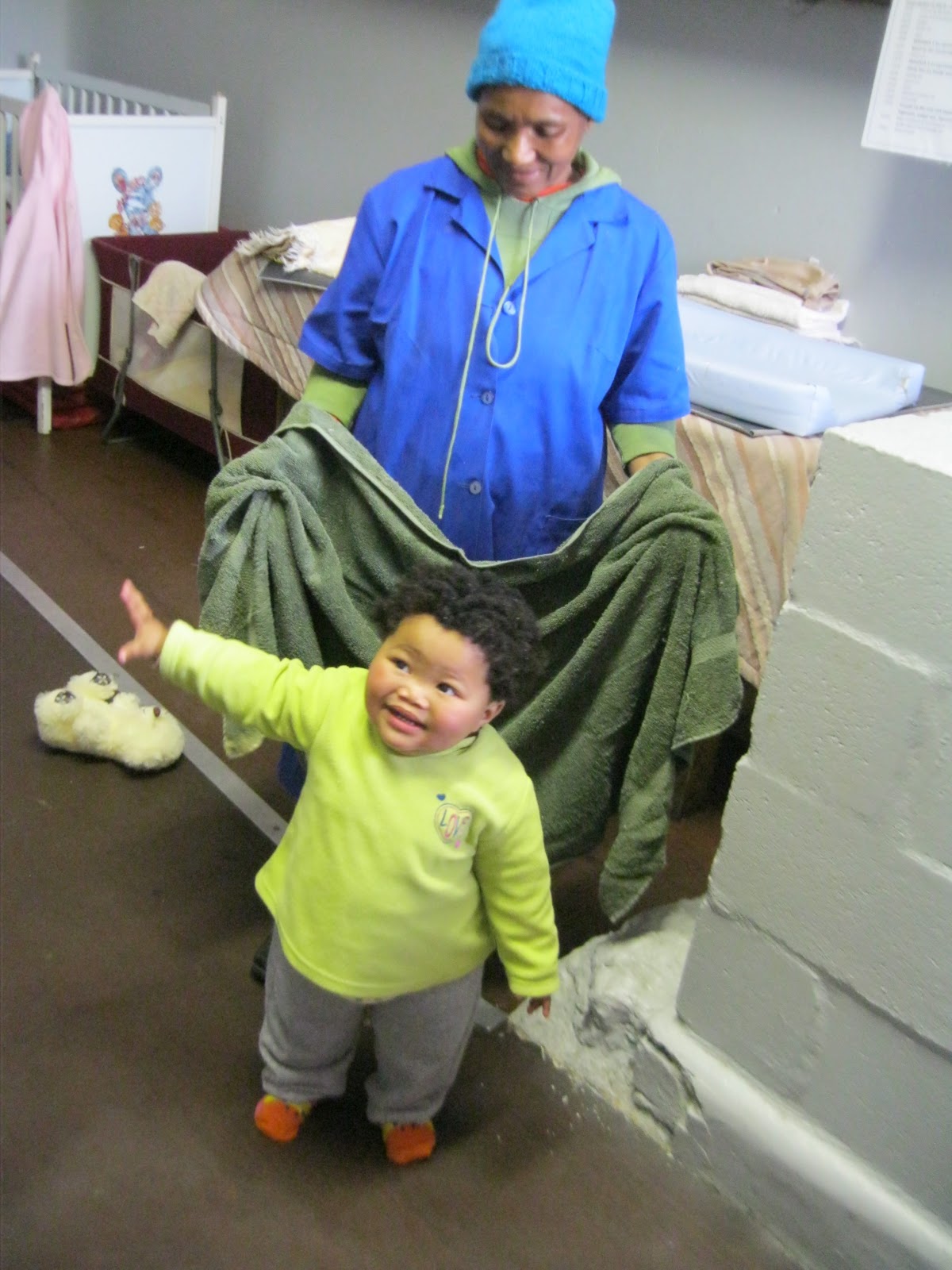
We visited the on-site creche to say hello to some of the most cutest children I have ever seen. As I walked in one of them was getting his hair washed. So cute!


The solar panels captured in this photo were funded by FT premium dollars. The installed panels provide heat for warmth and hot water. 


As I was photographing the solar panels, their neighbor called for my attention. He didn't speak English, but since he saw my camera I gathered he wanted me to take a photo of him. 


The Cabernet was pleasantly soft and subtle. Strong berry flavor. Smooth finish. FT is often criticized for outshining the quality of the product but I found their Cabernet competitive with similar-like wines.

I greatly enjoyed myself at Koopmanskloof and thank Rydal and Mario for welcoming me into their community and sharing their knowledge about the fair trade winemaking industry in South Africa. I have nothing but the utmost respect for Rydal's passion for and dedication to creating a family-like environment for his workers. 
For more information about Koopmanskloof you can visit them at their website, http://www.koopmanskloof.co.za/.

Monday, August 6, 2012

Stellenbosch - South Africa's Wine Capital

Stellenbosch is situated about 50km east of Cape Town. In addition to the 400+ wineries based on Stellenbosch it is also the home of Stellenbosch University, one of South Africa's leading Universities. This dangerous combination of a University located in the same area as a bunch of wineries equals a vibrant college community well-equipped with a plethora of restaurants, pubs, shops and YES you guessed it - drunk college kids. Needless to say the hostel was packed with University of Cape Town visitors Friday and Saturday, and then transformed to a ghost town Sunday and Monday. 

Ihyaka Backpackers was conveniently located in the Stellenbosch town center, so I spent many hours window shopping at all the small boutique-like stores. I'm 99% positive these hanging clothes served more of an aesthetic than practical purpose, but they did make for a nice photo op.


I arrived at Ikhaya Backpackers on a Wednesday, with a scheduled meeting with Koopmanskloof winery on Friday. With one day free in-between I signed up for a full-day wine tasting tour of course! For $50 I splurged on an all-inclusive 3 winery tour with lunch included. Our first stop was Muratie. 

Muratie was founded on a love story. Story goes, a German soldier in service of the Dutch East Indian Companyfell in love with a black slave in Cape Town.  They obviously had to keep their illicit love affair a secret, so once a month he trekked for three days from Stellenbosch to Cape Town to visit her, and then walked back. After some time he asked the black slave girl to move onto the farm with him. She became one of the richest slaves who ever lived. The love story still runs deep in Muratie's wine products. Ansela van de Caab, one of their best-selling wines,  is named after the slave girl.


Solms Delta is a winery with an impressive story. They pride themselves in empowering and giving back profits to their workers. In 2010 the owner of Solms Delta started a trust fund for its 150 workers. One-third of profits from their port wine is put into the trust fund which is then used towards college scholarships for the workers' children. I was talking to Eugene, a newly hired worker at Solms Delta about how he finds working on this farm. He said compared to other wineries, Solms Delta has a positive vibe, and its evident all the workers are happy to be there.

Berries start showing around Jan and are picked during March.

Fish & Chips (and a glass of white)

Our wine connoisseur Steven says the Solms Delta's trust fund has allowed his son to attend Stellenbosch University. While the trust fund is meant to benefit and empower the workers, he said something that is important to remember: "The point is not to get rich, but to get out of poverty. Not everyone can be rich." By the way, they have a Cape Jazz Shiraz which is a sparkling shiraz that is SO good. It's dry, not too sweet, and bubbly of course! 

Becky and Francis, two girls I met who also stayed at Ikhaya's Backpacker hostel. They're from the Channel Islands and spending the next year backpacking around the world. Must be nice!

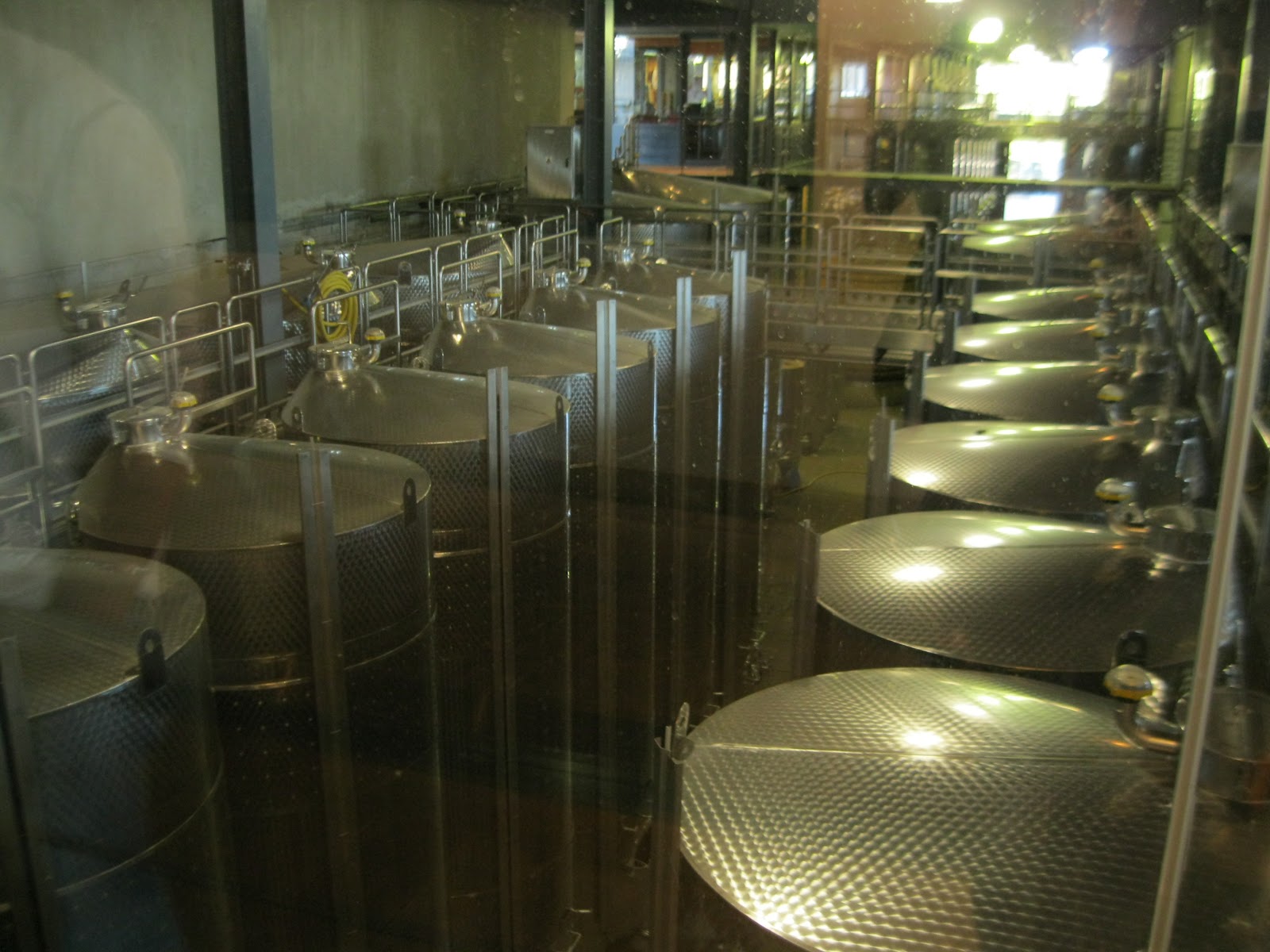
Fermentation tanks at Tokara.

Tokara's brandy, although they are most well-known for their award-winning Chenin Blanc.

Me, Chantal, Coen, and Michael at Bohemia - one of the many bars in Stellenbosch.

Just for kicks, here's some fun facts about Stellenbosch and its wine industry:
  • South Africa's wine industry is only reaching its peak. For the first time, in 2011 South Africa exported more wine to Europe than France.
  • Oak trees in South Africa grow too quickly due to the weather causing native South African oak to be too porous to be used as wine barrels. The wine seeps right through. As a result all wine barrels used in South Africa are either imported from Europe or the United States.
  • Speaking of wine barrels- one barrel is considered 'good' for storing wine up to four years. After four years it no longer contributes high-quality oak flavor to wine, and then is used for port and sherry wine for four years. Lastly, it is then used for whisky for another four years.
  • In Stellenbosch alone it is estimated that R4,000,000 is spent on alcohol annually.


Thursday, August 2, 2012

Waterfront Views and African Penguins

For the first few days in Cape Town it rained. But the last few days were bright and sunny! So I capitalized on the weather and headed straight for the coast. Lucky for me public transportation is decent enough, where I can get myself around for relatively cheap. My only other options are to rent a car (but they drive on right side of the car and the other side of the road, so hell no) or hire a shuttle/taxi (which can easily cost R200, or $25 one-way) so I'm thankful for the MiCiti and Metorail. The New Yorker in me sees no problem with public transportation!

Views from the Waterfront. I didn't take a photo of it, but from the Waterfront you can see the HUGE stadium where the World Cup 2010 took place. Because the World Cup was so recent, it makes a lot of sense why this area is so clean, modern, and new.

V&A Mall at the Wharf is your typical mall... bla bla. I didn't come here to hang out at the mall, but it was beautiful to look at!

Views from the Metrorail on the way to Simonstown and Boulders Beach.

Colorful houses decorate the bottom of the mountain landscape.

From what I understand Simonstown used to be and old Naval community. I did walk past the Naval museum, but I wasn't dying to learn more about Cape Town's Naval history - I'll pass, thanks. Simonstown however, is quaint and adorable! The street is lined with small Mom & Pop shops, and I was nearly distracted by every single one on my 2m walk from the train station to Boulder's Beach.


Well there you have it - your Fun Fact of the Day!

After my 2m trek I arrived at Boulder's Beach - 'Home of the African Penguin'. The beach was well-kept and it felt almost like a Sea World amusement park-ish. There were several vendors outside of the park selling penguin memorabilia, stuffed animals, hats, ceramics, and others. Entrance was R40, the most expensive admission price I've paid in South Africa yet. Let hope the R40 goes towards keeping the little penguins' home clean and safe. 

Boardwalks to the penguin viewing site.

SO CUTE. Need I say more?


Apparently its common for penguins to escape the fenced area. They enjoy frolicking in vegetation and surrounding the beach,  on the other side of the green meshed fence is residential. Coincidentally most of the residential houses have gardens that look very similar to vegetation on the beach. Oftentimes the penguins are seen climbing the mesh fence and into running across the pavement and into people's front yards. Even while I was there a worker on park patrol was handling this exact situation.  

They were so close you wanted to grab one and put it in your pocket!!! Gah! 

I'm sure others have thought the same thing. Hence the sign.

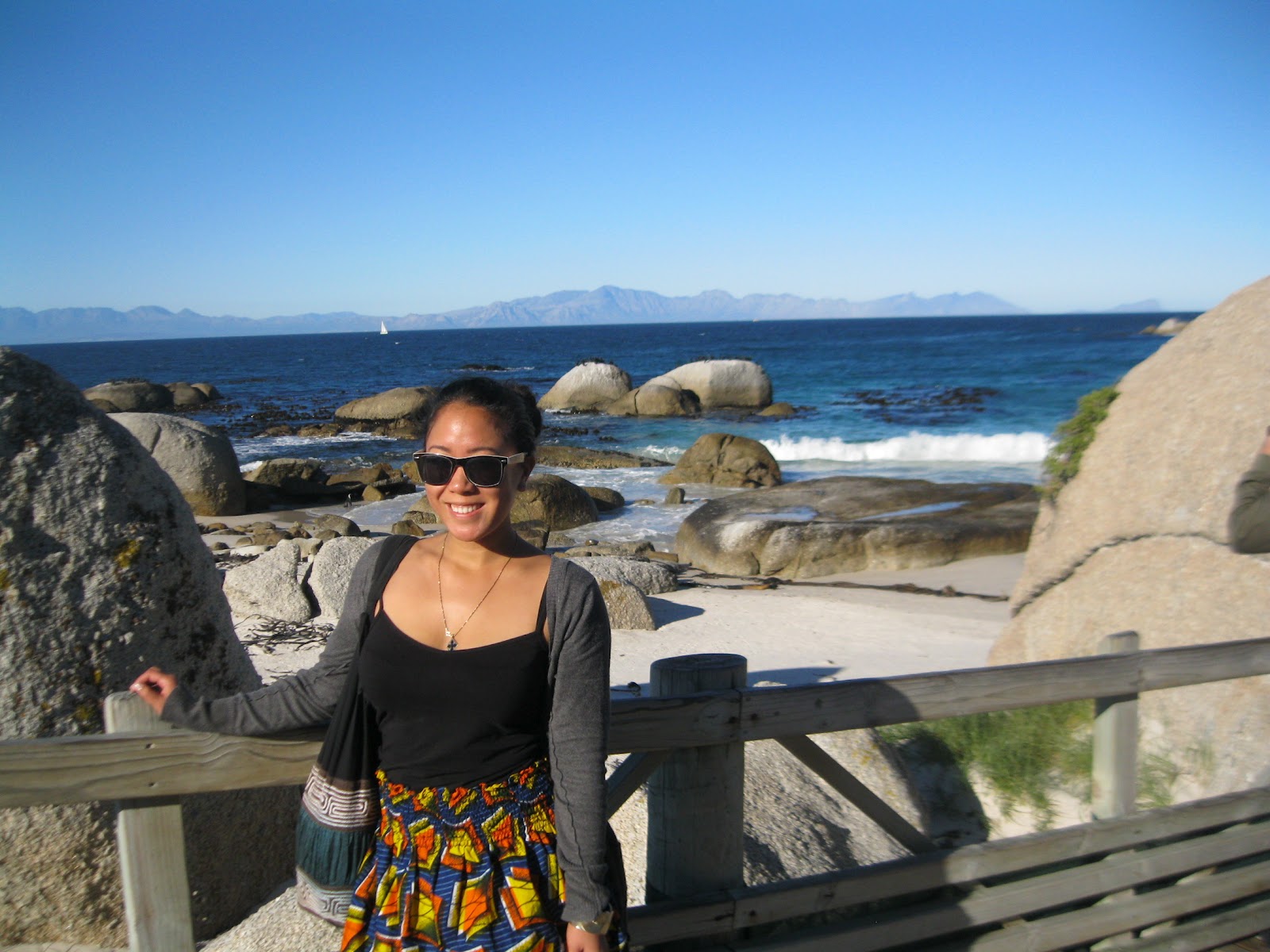
Alright, one picture of me is okay.

In real-time news, I arrived in Stellenbosch yesterday and checked into the Ikhaya Backpackers Hostel. I splurged on a wine tour today, spending about $50 for a full-day tour that visits 4 wineries and includes lunch and all wine and cheese tastings. So compared to Napa prices, super cheap. Plus, there was no way I let myself pass through Stellenbosch, the 'wine capital of South Africa' and not splurge on a wine tour. Leaving soon, can't wait!

Thursday, July 26, 2012

Tentative Cape Town Itinerary

Switching my Ghana Brandt for the South Africa Lonely Planet

Just touched down in Cape Town, South Africa! Im tired and the flight was long including a one-and-a-half layover in Windhoek, the capital of Namibia. Can't believe I'm here but I'm ready to hit the ground running. I've had this post in draft version for a while... but here's my tentative plans for the Cape Town leg of my journey- 

Upon arrival I'll head straight to the Cape Town city center and stay for about five nights or so. During this time I'll let Cape Town soak in, get situated, and familiar with my travel options to my two main destinations: Stellenbosch, Cape Town's vast wine land, and Citrusdal, located a few hours North of Cape Town and home to citrus and rooibos tea farms. Stellenbosch makes for a first stop because it's a popular destination from Cape Town, only about 45 minutes outside of the city center. There are some wineries I've bookmarked in my handy dandy Lonely Planet that are a must-visit. From Stellenbosch I'll make my way towards Citrusdal, located North of Cape Town and much more rural and less-travelled than Stellenbosch. 

It might help to explain a little bit more about what I'm researching in Cape Town before I list the places I intend to visit. My trip is two-pronged, hoping to research the impact of two interrelated areas in the South African context:
  • Fair Trade impact, specifically the impact of Fair Trade USA certified organizations. Please note that my visit is completely voluntary and is not by any means an official audit on behalf of Fair Trade USA.
  • The impact of the Broad-Based Black Economic Empowerment (B-BBEE) legislation of 2003. As a final assignment for the NYU Wagner's Food Security and Hunger course we have to write an independent research paper exploring any issue related to food security and/or global hunger. Since I needed to conduct research on Fair Trade in the South African context anyways, I decided to research and explore a Fair Trade standard unique to Fair Trade organizations in South Africa. The B-BBEE Act of 2003 is unique to South Africa because it was initiated by the South African government as a result of the apartheid, aimed to distribute wealth as evenly across the peoples of South Africa as possible- including blacks. So far I've found some controversial information regarding the impact of B-BBEE which I've decided to explore further. 
Below is my tentative itinerary and prospective sites I plan to visit, all of which are FTUSA certified producing organizations. About half of them are confirmed, while the other half is still TBD.
  1. Cape Town (5 days)
  2. Stellenbosch (5 - 7 days)
    1. Koopmanskloof Wingerde - wine grapes
  3. Robertson, about an hour east of Stellenbosch (3 days)
    1. Van Loveren (Pty.) Ltd winery - wine grapes; also notable for their commitment to B-BEEE
  4. Citrusdal (5 - 7 days)
    1. ALG Boerdery (Pty. Ltd) - lemon 
    2. Bergendal Boerdery - wine grapes, oranges, rooibos tea
    3. Mouton Citrus - citrus fruit
    4. Citrusdal Wines - wine grapes
  5. Clanwilliam, about an hour north of Citrusdal (3 nights)
    1. Wupperthal Original Rooibos Cooperative/ Heiveld - rooibos tea
  6. Return to Cape Town (~ 2 weeks)
    1. PARTY! haha, only kidding. Wrap up data collection & NY job hunting
Other notable FT, not necessarily FTUSA certified, or B-BBEE associated sites worth adding to my itinerary, depending on their accessibility and ability to fit into my schedule (description credit goes to Lonely Planet):

  • Both Solms-Delta and Van Loveren (www.vanloveren.co.za) have made their employers shareholders in newly purchased joint-venture wine farms. Nelsons Creek, north of Paarl, (www.nelsonscreek.co.za) donated land to his workers to produce their own wines under the label New Beginnings.
  • Thabani (not open to the public) is SA's first wholly black-owned wine company
  • Thandi, Elgin area, (www.thandi.com) first winery to become FT certified
  • Tukulu, Darling area, is the flagship BEE brand in the stable of industry giant Distell

Although was sad to leave Ghana, good news is that I'll be back! I fly from Cape Town to Accra on August 26th before departing back to New York August 28th , giving me 2 days to do last minute souvenir shopping, pick up extra yards of fabric from Kaneshie market, and say bye to some friends. Until then, see you later Chale! (Chale is slang for 'dude'... pronounced 'Chaa-Lay' although I mistook it for 'Shalane' long before I understood what it meant.)